By Ruth Guise
During a conversation with a friend about an idea she had for a POP article, I asked her where her inspiration had come from. She lives in E7, and with two active boys they spend a lot of time on the beach, collecting shells and all the other interesting bits and bobs that wash in and out each day. It hadn’t occurred to her that some of the innocuous looking seeds might actually be harmful, until she visited the Belait Museum. She thought an article could be helpful for other beach lovers with curious children.
“There is a museum in KB?” I asked with great surprise, shortly followed by: “and more importantly, is it worth visiting?”
I decided to find out for myself, and after heeding her advice that it looks like it is shut, we parked on the grass after finding there was no obvious carpark. Winding our way through a bank of Mercedes and government-logoed jeeps that indicated we would be joining some local dignitaries on a tour, we found the unmarked entrance and were greeted politely by a member of staff.
The Belait Museum building once housed the Assistant British Resident back in the 1930s, and was later the residence of the Belait District Officer in the 1990s. It has served various functions including hosting His Majesty during visits to Kuala Belait. It is easy to find at the west end of Jalan Maulana, although the signposting can be described as subtle at best. You don’t need a ticket and it is free to enter.
The museum has five galleries themed around the administrative and commercial development of Kuala Belait, natural history, oil and gas, a cultural gallery and a temporary gallery which was showcasing a pleasant, bijoux collection of local art when we visited.
The Belait Museum building once housed the Assistant British Resident back in the 1930s, and was later the residence of the Belait District Officer in the 1990s. It has served various functions including hosting His Majesty during visits to Kuala Belait. It is easy to find at the west end of Jalan Maulana, although the signposting can be described as subtle at best. You don’t need a ticket and it is free to enter. The museum has five galleries themed around the administrative and commercial development of Kuala Belait, natural history, oil and gas, a cultural gallery and a temporary gallery which was showcasing a pleasant, bijoux collection of local art when we visited.
Nature
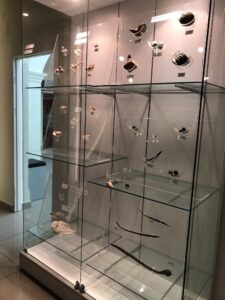
The natural history gallery is small; it has some skeletons and models of wildlife we are familiar with here in Panaga, as well as other parts of Brunei. The seed and pod display cases house specimens of what we see regularly on the beach in Panaga, and piqued the interest of the friend who suggested giving it a mention in POP, featuring items with names such as ‘Blind-your-eyes’ and ‘Pong-pong’. The former contains a latex-like sap that can cause blisters and even temporary blindness; another part can be used as fish poison (which begs the question as to when fish are destined for such a fate!); other parts of the plant can be used for anything from making dye, to allegedly being able to cure gonorrhoea. ‘Pong-pong’ is said to be both poisonous and an effective insect repellent, so user caution is advised!
Culture
The largest gallery is the cultural exhibition, and this details the geographical settlements and movement of the local tribespeople, and subsequent transition into what is now an integrated, multicultural society.
It was fascinating to learn how the lives of the five main tribes in the Belait region differed in terms of dialect, farming practices, rituals and accommodation despite all living between Labi and the Sarawak border; distances that we take for granted as a quick commute actually contained very separate communities up until the Second World War.
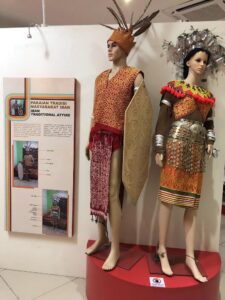
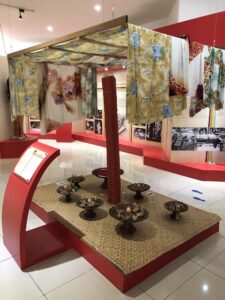
The exhibition is heavy with narrative, albeit clearly and engagingly written in both Bahasa Melayu and English, on well designed boards. For visitors of all ages, there are various models and displays ranging from a longhouse, mannequins with traditional dress, a loom, archaeological finds of tools and examples of other household items used by the tribes.
A highlight was learning about the reverence given to the rice harvest, and all the myths and rituals surrounding it. As farming was mechanised, and other crops introduced, such practices have fallen away. However, it gave a wonderful sense of how these communities worked with nature.
Understanding how tribes from Sarawak came to settle in Brunei, the impact of the Japanese invasion, and the interaction between British colonial settlers, Chinese, Malays and the indigenous communities charts an interesting pathway into what we experience today in modern Belait.
Development and Industry
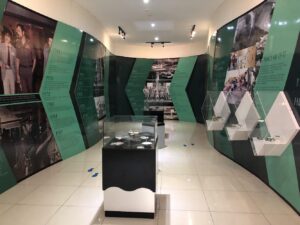
In two further galleries, bright and clear graphical timelines set out the transformation of the Belait area from a predominately subsistence farming region, to the powerhouse of the Bruneian oil and gas industry. With this industry being the sole reason for the existence of the Panaga community it is very poignant to see how, visually laid out, the initially slow foray into exploration gained pace and rapidly dominated. Having enjoyed reading about the historical culture of the indigenous people, it was fascinating to ponder what this quiet side of Brunei would be like, had oil exploration not become such an invaluable source of wealth for this tiny country.
The pop up art gallery was unexpected and it is always delightful to have the opportunity to see the work of local artists. All the pieces were for sale.
Recommended?
Overall this was a worthwhile and thought-provoking excursion, and proved to be a reminder that Brunei’s roots are based in tribal culture and tradition, as well as the Malay and Islamic perspectives that dominate modern society.
For little ones the Belait Museum may provide limited entertainment, however for any children of confident reading age then this is certainly worth a visit; we happily passed an hour, after which we felt more connected with our temporary home, and with the notion that we would like to continue to learn more about Brunei’s rich history.
Belait Museum states on its website to be open Saturdays to Thursdays 9am to 5pm, with last entry at 4.30pm, however the experience of others in the past has been that it is not always open. There is no telephone number listed online, so you will have to try your luck!