Ramadan: Q&A With Ayesha

Last week, Ayesha gave a fun and informative presentation to help non-Muslims understand what to expect during Ramadan, which begins soon. Read on to hear her personal reflections on this holy month of fasting that means so much to Muslims worldwide.

What’s your favourite thing about Ramadan?

Must I pick only one? Ramadan is a month full of unity for Muslims. The devil is locked away so all our deeds are a reflection of who we are. We are encouraged to fast together, pray together, eat together and pray for each other. There is a sense of belonging and because of this, people’s hearts are open to forgive and be the best version of themselves. There is no better feeling that breaking your fast with your fellow Muslim brothers and sisters, or basically anyone who has felt the hunger you have felt for that day!
What do you want non-Muslims to know about Ramadhan?

Ramadan is not extremely restrictive. It’s not hurtful nor is it forced upon children, the sick, or those new to Islam. It’s a time to recharge our battery so to speak.

As Ramadan only comes once a year, it’s the time of reflection and peace. For some, not taking water or food for the day sounds extreme, but as with anything, it’s a habit learned and quite easy after you begin. We sleep all night without food or water, hence waking up a little early, having a morning meal and then knowing you will have an evening meal is a luxury not many around the world have.

Also, it’s not just our bellies that are fasting it is our eyes from watching things that are not good, our tongues from not saying bad words or hurtful comments, it is our entire body. Of course it’s not sustainable year round. That’s why it’s a special month that unites all Muslims to come together for a month of extra reflection.

What are some misconceptions about Ramadhan?

Misconception #1: We don’t eat or drink for an entire month. Nope. We have a morning and evening meal. We can eat all night if we want, the day resets at sunrise.

Misconception #2: We force kids to fast. Nope. Fasting is not mandatory on a child until they hit puberty and then there is a lot of Mercy if a young child cannot complete a fast. This goes for the sick and for those working in conditions that may be difficult for them to finish a fast such as a construction worker who works in the heat all day.

Misconception #3: Muslims abstain from any intimacy and cannot be near their spouse. No, Muslims refrain from temptations and intimacy only during the fasting hours.

Misconception #4: Muslims are offended if you eat in front of them in Ramadan. Nope. Muslims fast and are not bothered by others eating in front of them. Of course, no one needs to be enjoying a whole meal in front of a fasting person out of spite, however we can assure you that resisting temptation and practicing self-control is part of Ramadan’s core purpose. This may be harder for kids when they are learning to fast, but on the whole, it’s weird if you try to hide and eat and make it weird.

Just remember, follow the rules of the land you live in. While living in beautiful Brunei, remember to sensitive to the needs of others. Do not eat in public until after sunset.

What’s a favourite memory you have of Ramadhan?

My favorite memory of Ramadan is when my husband led the prayers in the masjid back when we lived in Colorado. It was an amazing feeling being surrounded by beautiful mountains, amazing people, and hearing his insanely beautiful recitation.

The top reason for my “yes” when he asked for my hand was being able to hear him recite every day for the rest of our blessed lives. Three kids later, here we are!

Hidden Gems: The Honey Bookstore

By Nova Dudley-Gough 

I first encountered The Honey on Instagram; a post of theirs showed their beautiful colour-coordinated books. As I order my books the same way (it just looks so pretty and tidy!) and there really aren’t enough book shops in Brunei, I felt that I already had a connection to this place. A couple of meetings at the Art and Eat Fair showed me the quality of books that the owner, Sally, has in stock and so I was desperate to go and see what else this place had to offer.

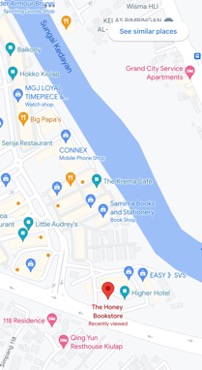
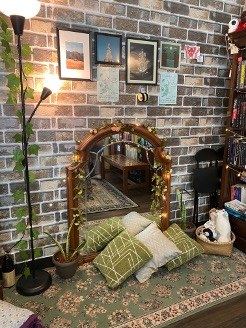
Tucked away upstairs in the same block as the Higher Hotel in Kiulap, The Honey is open by appointment only. It’s a cosy, safe, space, with a mixture of second hand and perfectly curated books, including a small children’s selection and plenty of classics and modern Bookstagram and BookTok friendly titles too. It’s appointment only because this place is more than just a shop: it’s an event space, a personal reading nook (cushions and rugs line the floor, and there is a comfy armchair for reading too), even a spot to work on art or watch a movie.

The Honey was inspired by bookshops in the UK, where people can spend time browsing a wide variety of titles, have a cup of tea and sit and enjoy the atmosphere. Indie bookstores have a unique feeling, a magical place, and that’s what The Honey is trying to create. It’s a safe and inclusive space, no matter where you come from or what you believe — the expat community is very welcome as are local readers. 

Sally really believes that the culture of reading for fun has been neglected in this part of the world. While reading books in international schools is encouraged and seen as a good thing, it can take second place to sports in some local schools. Sally makes sure she stocks a wide variety of books to try and spark some excitement about reading to young people who may not have had the exposure to reading or don’t know where to start with titles they might enjoy. 

Some recent activities that have been hosted by The Honey include art sessions, movie nights, group reading and even private sessions, where you’re left alone with just a cup of tea and a book of your choosing. I know I’d pay for that privilege! 

Sally likes books that are second hand, finding handwritten notes and forgotten bookmarks inside them. She is also involved in hosting literary events with non-profit group Bruneians:Read (Instagram: @BruneiansRead), and initiating charity book donations to instil the love of reading in Brunei. The years of volunteering, hustling and connecting with people have  created a very aesthetic location with an eye for how it will look on social media as well as for the people who are also there just for the books — because if you can get people in the store because of the vibe or how pretty is looks, they’re more likely to buy a book (or two) and share the experience with their friends. And if that makes more people read, that’s great.

The Honey plans to have more pop-ups in malls and also in Panaga, so keep an eye out. And the next time you’re planning to head up to Kiulap, make an appointment and enjoy this literary oasis. 

Owner: Sallyhani Hazman
Email: hello@thehoneybn.com
Address: Block A, First Floor, Higher Point Complex, Kiulap, Brunei
www.thehoneybn.com
Instagram: @thehoneybn FB: The Honey BN

Festival Food… Chinese New Year Bao

By Pixie Ang

“Bao zi” or just “bao” is a staple food in parts of China and can be eaten as a meal. It is a more bready and fluffier version of dumplings. Bao is a popular Chinese New Year food symbolizing wealth and treasure. I was lucky enough to be invited by the culinarily talented Iris Tao to learn how to make bao, and readers, we are lucky that she was happy to share her recipe with you all.

Like many Chinese dishes, the recipe has some flexibility to cater for individual taste and preferences. In true Masterchef fashion, Iris doled out ingredients by feel and cooked with experience rather than with scientific precision and measuring tools. Here is her recipe as best as I can recount. Happy steaming!

Ingredients: Dough

  • 1kg pau flour (can be found in SupaSave). Plain flour can also be used but pau flour gives a finer texture and appearance
  • 10g of yeast
  • 500ml of warm water
  • A teaspoon of sugar
  • A dash of salt

Ingredients: Filling

  • 1 kg boneless chicken thigh meat (you may use chicken mince or any other type meat)
  • 500-800 g of Chinese cabbage or wongbok
  • 3 cloves of garlic (minced)
  • thumb-sized piece of ginger (minced)
  • 20 ml of vegetable oil
  • 2 teaspoons of salt
  • 1 teaspoon of pepper
  • 1 teaspoon of chicken stock powder
  • 1 egg

Method: Dough

Place the flour in a large bowl with enough room for the dough to rise. In a small bowl, mix the yeast with the warm water and add the sugar and salt. Let it rest for 5-10mins.

Slowly pour the yeast mixture into the flour and mix. Once all the yeast mixture is added, knead the dough. If the dough is sticky, add a bit of flour. Roll the dough into a ball, then cover the bowl and let it rise for 1.5 hours or until doubled in size. To accelerate the process, you can put it in the oven at a low temperature (no more than 40 degrees Celsius).

Method: Filling

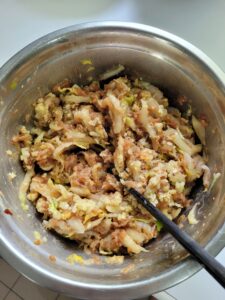
Chop the chicken meat finely and place in a big bowl.

Wash and finely chop the wongbok. Place the chopped wongbok into a bowl and add a teaspoon of salt. Leave for 15-20mins then throw out the water and squeeze any excess out of the vegetable. Add the salted wongbok to the chicken meat.

Heat the oil in a small pan and toss in the garlic and ginger. Fry until golden and add to the meat and vegetable mixture while hot.

Add a teaspoon of salt, pepper and chicken stock powder to the mixture and stir.

Crack and add the egg. Mix until combined.

Making the Bao

Knead the dough briefly and portion out about a quarter of the dough onto a flat flour-dusted area. Roll into a thick log about 4cm in diameter and cut into approximately 8cm cylindrical blocks. Keep the rest of the dough in the bowl and covered to prevent drying out. Taking one of the mini cylinders, place it so the cylinder is standing on its circular face. Using the flat of your palm, squash it down flat into a circular shape. You can use a rolling pin to flatten the circular dough to about 5mm thickness (you can make it thinner but it cannot hold as much filling).

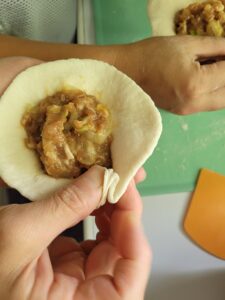
Scoop out about one tablespoon or so of the filling mixture into the centre of the flattened dough. Holding the bao in the palm of one hand, use the thumb and pointer/index finger of the other hand to pinch the edges of the dough together. The technique is difficult to describe. This video shows a number of techniques and the first (traditional) fold is the one we used: YouTube Bao Video.

Place your bao into a steamer, making sure you place baking paper or something between the bao and the steamer so it does not stick. Leave room for the bao to expand in the steamer. Repeat until the dough and filling is finished. If you cannot fit all the baos in the steamer at the same time, keep the baos covered while waiting for their turn in the steamer. Steam for 15 minutes and they are ready to eat. Enjoy!